I love to have salad dressings on hand, ready to be pressed into service! Here are four recipes, tried and true, that I use constantly, as an offering for you.
So versatile, for a salad, a dip for raw veggies (great for packed lunches!), or to quickly put together a slaw for tacos – just mix with shredded greens (kale, cabbage, collards, etc.). Easy and delicious!
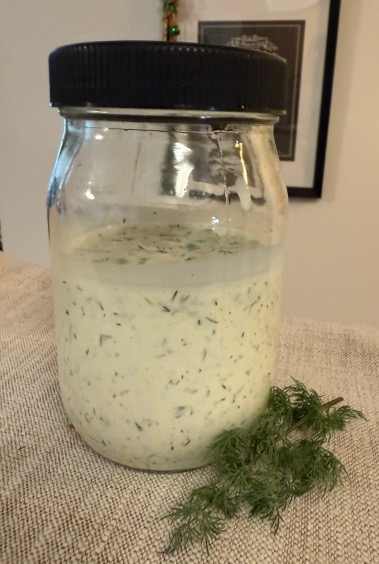
Buttermilk Dill Dressing
½ cup buttermilk ⅓ cup mayonnaise 1½ Tablespoons fresh lemon juice 2 Tablespoons chopped scallions 1 garlic clove, minced 2 Tablespoons chopped fresh dill Salt and pepper to taste
Mix all ingredients together with a whisk. Allow at least an hour for flavors to blend. Will keep, refrigerated, for 2 weeks.
Blue Cheese Dressing
Another classic, great to have on hand as a dressing or dip!
⅓ cup mayonnaise ¼ cup heavy cream 2 Tablespoons sour cream 1½ Tablespoons fresh lemon juice ½ teaspoon Worcestershire sauce ½ cup blue cheese, crumbled Salt and pepper to taste
Mash half of the blue cheese, then mix with other ingredients. Mix in the rest of the crumbled cheese. Allow at least an hour for flavors to blend. Will keep, refrigerated, for 2 weeks.
Asian-Style Sesame Dressing
For salads, or top a protein.
2 Tablespoons soy sauce 2 Tablespoons balsamic vinegar 2 Tablespoons rice or white wine vinegar 2 garlic cloves, minced 2 Tablespoons finely chopped scallions 1 Tablespoon light miso 1 Tablespoon honey cup vegetable oil Freshly ground pepper to taste 2 Tablespoons toasted sesame seeds, white or black or a combination
To toast sesame seeds, stir in a small skillet on medium heat for a few minutes, until lightly colored and fragrant, then remove to a plate to cool.
Mix all ingredients with a whisk. Allow at least an hour for flavors to blend. Will keep, refrigerated, for 2 weeks.
Tahini-Lemon Dressing and Sauce
Use for salad, falafels, or dipping!
½ cup tahini, stirred ⅓ cup cold water 2 garlic cloves, minced 1 teaspoon maple syrup or honey 1 teaspoon lemon zest 1½ Tablespoons fresh lemon juice Salt and pepper to taste
In a blender or food processor, blitz all ingredients. If a thinner consistency is desired, blend in a bit more cold water, one teaspoon at a time. Allow at least an hour for flavors to blend. Will keep, refrigerated, for 2 weeks.
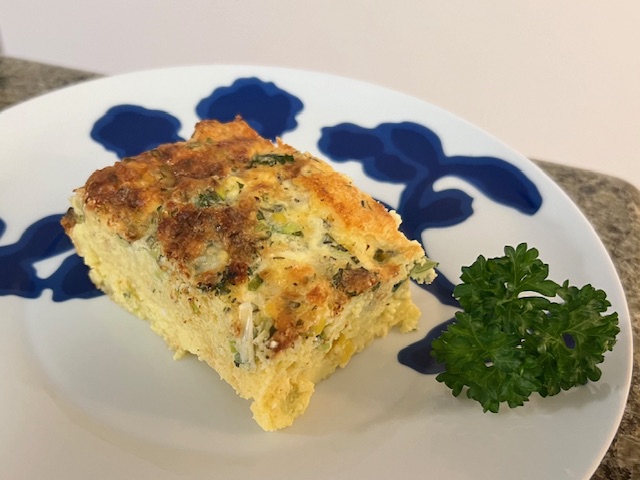
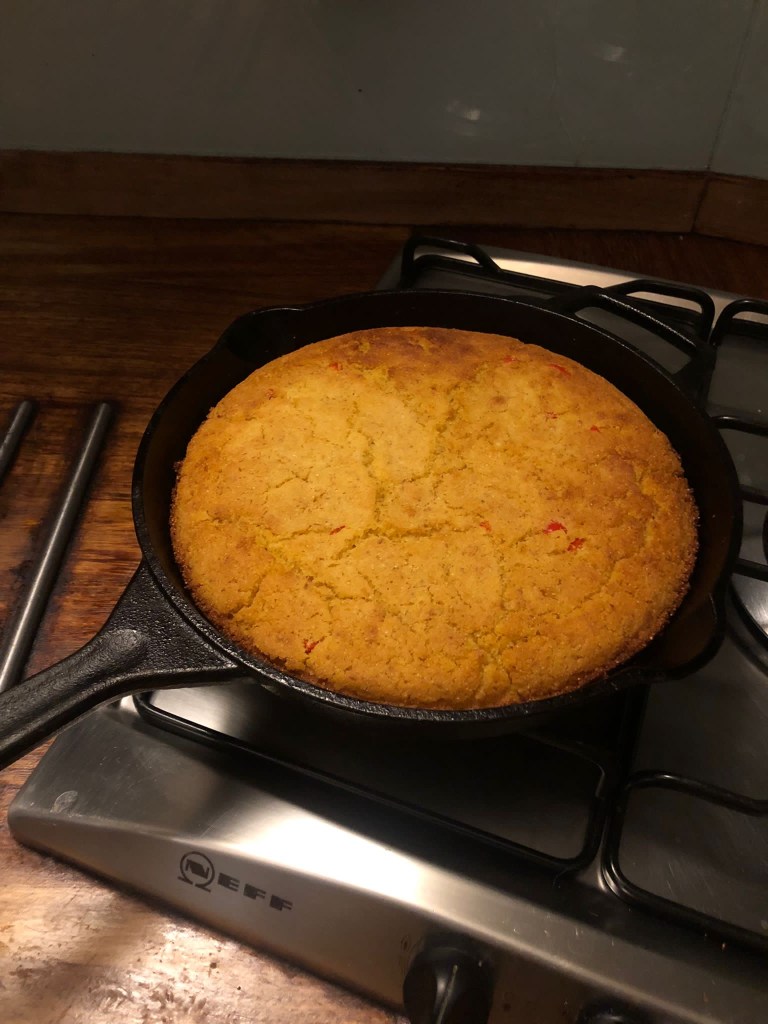
Cornbread pudding from homemade skillet cornbread, or any cornbread.
1 cup milk 1 cup half and half or heavy cream 4 eggs, beaten ½ teaspoon salt Fresh ground pepper to taste 1 cup corn kernels (fresh, thawed frozen, or canned) 3½ cups leftover cornbread (about 10 ounces), broken into pieces (about 1-inch) 2 scallions, chopped 1 tablespoon chopped parsley ½ teaspoon chopped fresh rosemary 1 teaspoon chopped fresh thyme 4 ounces grated cheddar cheese
Butter a 9 x 13-inch baking dish.
Whisk together milk, cream, eggs, and salt and pepper. Mix in corn.
Arrange cornbread pieces in the bottom of the baking dish. Sprinkle with scallions, herbs, and cheese. Pour egg mixture over top. Let stand for 10 minutes. Press down a bit with the back of a spoon.
Preheat oven to 425°F. Bake 40 minutes, or until browned on top and set in the middle.
These are great for using extra tortillas! You can use whole eggs, or a combination of eggs and egg whites that you may have frozen or saved after using the yolks (see ice cream recipes, for instance!). They’re perfect for breakfast or a snack, and can be frozen and reheated easily.
Ingredients Tortillas (corn or flour) (use about 3-4 tortillas, or more for street-sized tortillas) 2½ cups eggs (or a combination of egg whites plus whole eggs) 1 tablespoon milk ½ teaspoon mild chile powder (such as New Mexico chile powder) ¼ cup cilantro, chopped Salt and pepper Hot sauce to taste 3 slices bacon, chopped ½ cup spinach (or other greens such as kale or chard), chopped 1 tablespoon olive oil ½ teaspoon cumin powder 2 large garlic cloves, minced ½ cup diced tomatoes 2 tablespoons onion or scallions, chopped ¼ cup cheese (grated cotija, cheddar, jack, etc.)
Beat eggs with milk. Add chile powder, cilantro, salt, pepper, and hot sauce, and mix well. Set aside.
In a nonstick skillet, fry bacon pieces until crisp. Remove to a paper towel to drain. Pour out most of the bacon fat, add the oil, and sauté the greens for about 3 minutes. Add cumin and garlic and cook 1 minute more. Remove from heat.
Wrap tortillas loosely in paper towels and microwave 15 seconds. Slice into quarters or smaller triangles, depending on size of the tortillas.
In a 12-cup muffin pan, arrange the tortilla pieces, overlapping, to cover the sides and bottom of each cup, extending over the sides a bit.
Divide the greens mixture, then the tomatoes, scallions, and cheese among the muffin cups.
Pour the egg mixture into the muffin cups, filling each one.
Preheat oven to 375°F and bake 20-25 minutes, until cooked. Let cool in pan for 5 minutes, then remove from pan, using a table knife to assist.
Serve warm or at room temperature with desired toppings, or cool and then freeze (reheat in microwave for 45 seconds).
What a pastor is learning from cooking in a pandemic
I saw a post recently where someone was berating himself as a worthless lowlife because he bought three plums, put them in the fridge, and then two weeks later, had to throw them away. It happens. And when it does, we are reminded of the many who don’t have the luxury of tossing spoiled food into the trash. Yet perhaps, in these times, we can show our gratitude for what we are blessed to have by using up what’s already here!
Wait, you say. There’s nothing here! So here is the beginning of a short series called … Delectatio ex nihilo (enjoyment out of nothing!).
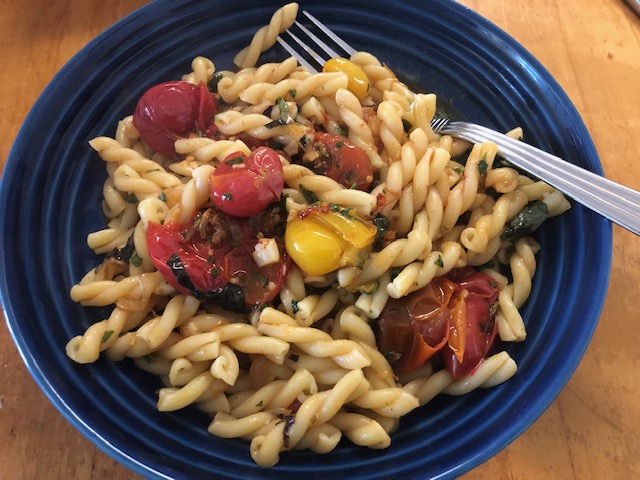
Burst tomatoes with gemelli!
Now, as you may know, the idea, extrapolated from the Creation account in Genesis, is that God created the world ex nihilo (out of nothing): kind of God’s Big Bang. God speaks, and things come to be, where previously no things were. The idea has a complicated history. Suffice to say that not everyone was on board.
Maybe I’m more with the ex nihilo nihil fit camp, who argue “NOT out of nothing” – that there was SOMETHING THERE to begin with. Along these lines, God might have proclaimed, “Thou shalt not throw it away!” and “There shall be leftovers; and behold, it was good.”
So here I have two recipes to start off our Delectatio ex nihilo series, which is to say: pleasurable, delicious things made from what SEEMS to be nothing – nothing in the house, nothing in the fridge – oh wait, there are these wrinkly-looking cherry tomatoes and some garlic, what can we do with these?
Roasted tomatoes
Here are two recipes for Burst Cherry Tomato Sauce (plus other tomatoes that may be hanging around), and one for Melted Peppers, for those less than fresh peppers you don’t know what to do with but toss. Don’t toss them! We’re making delicious stuff where there seemed to be NO stuff! (Sure, you have to run down some XO sauce – some grocery stores have it, or you can buy it online, or if you’re really ambitious, there are recipes online – it keeps a long time! Just tuck some away for a rainy day.)
Burst cherry tomatoes, Take 1
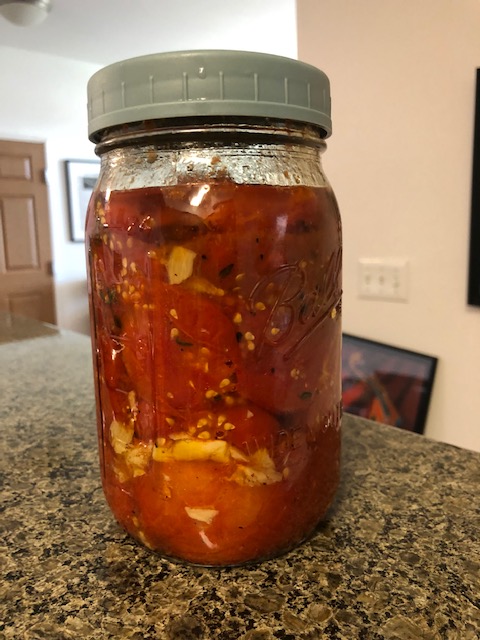
Slow-roasted tomatoes with lots of garlic
This is a great way to use up miscellaneous wrinkled cherry tomatoes, or saggy regular tomatoes you have hanging around. Just cut off stem pieces and any bad-looking parts. After cooking, the tomatoes can be put in mason jars, used for bruschetta, or for pasta (with some burrata on top is nice), or to make a sauce. Or freeze for a later date. You can blitz in a food processor or with an immersion blender if you’d like to smooth out the skins and seeds.
1-2 pounds cherry or grape tomatoes, any color (or add quartered or halved regular tomatoes) 10 cloves (at least) garlic, peeled and well-smashed (if they come apart, that’s fine) Extra virgin olive oil Salt and pepper Pinch of sugar Pinch of hot pepper flakes Several sprigs fresh thyme ¼ – ½ cup white wine or dry vermouth Cooked pasta (any type, long or short), reserving ½ cup pasta water
Preheat oven to 375 F. Place the tomatoes and garlic in a roasting pan and add enough olive oil to coat them well. Sprinkle with salt and pepper, a pinch of sugar, and hot pepper flakes, and mix well. Tuck in the thyme sprigs. Roast for 45 minutes, until starting to split.
Transfer to a bowl. Add about ¼ cup white wine to the roasting pan, heat briefly, and stir with a wooden spoon to deglaze and dislodge any stuck bits. Add the liquid to the bowl with the tomatoes. Fish out the thyme sprigs, leaving the leaves behind in the sauce. Crush the tomatoes a bit with a wooden spoon or potato masher.
Transfer to jars and use within a few days, or freeze.
If serving with pasta, heat the sauce with a bit of cooking water, taste for salt and pepper, and mix with the pasta. Serve with burrata and/or grated Parmesan or Romano cheese.
Burst cherry tomatoes, Take 2
Roasted tomatoes with XO sauce and herbs
Note: XO sauce is a chunky flavorful sauce made of dried seafood, chili peppers, onions, and garlic that originated in Hong Kong. It can be found in Asian stores and online, and there are also recipes are online. It’s wonderful as a table sauce, and can be added to meats, fish, vegetables, or pasta.
12 oz short pasta (penne, rigatoni, fusilli, whatever you have) 3 T extra virgin olive oil 6 garlic cloves, peeled, and well-smashed (if they come apart, that’s fine) 1 pound cherry or grape tomatoes (or add quartered or halved tomatoes to equal 1 lb) Salt and pepper Pinch of red pepper flakes ⅓ cup XO sauce (see note) ½ cup chopped basil ½ cup chopped mint
Cook pasta 1 minute short of al dente. Drain, reserving 1 cup pasta water.
Preheat oven to 425 F. Put tomatoes in roasting pan and toss with olive oil, garlic, salt and pepper, and red pepper flakes. Roast for about 30 minutes, or until slightly browned and starting to burst.
Transfer tomatoes to the saucepan you cooked the pasta in, after you’ve drained the pasta.
Rinse the roasting pan with ¼ cup pasta water. Heat the pan briefly on the stove, stirring with a wooden spoon to deglaze and dislodge any stuck bits. Add the liquid to the saucepan (scraping out every delicious drop!). Mix in XO sauce and mix over medium heat, crushing tomatoes a bit with a wooden spoon or potato masher. Toss with pasta, heat briefly, adding more pasta water if necessary. Mix in basil and mint, and taste for salt and pepper.
(Adapted from a Serious Eats recipe.)
Melted peppers
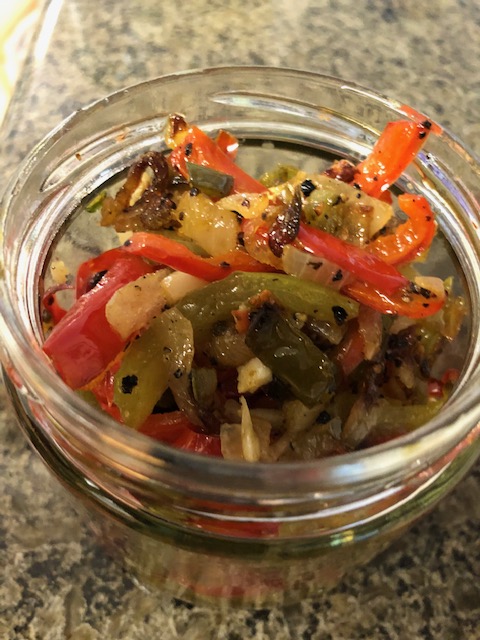
Melted peppers – ready for sandwiches, bruschetta, pasta!
These are good on everything – toasted bread or crackers, with pasta, on a burger or grilled cheese, or really any sandwich. Peppers somewhat past their prime can be used, either bell peppers, any colors, or mini sweet peppers.
¾ cup extra virgin olive oil 2 pounds sweet peppers (any color, any size), seeded and sliced 1 jalapeño pepper, seeded and finely diced 2 medium onions, thinly sliced 6 cloves garlic, thinly sliced Several sprigs thyme ½ teaspoon salt Pepper to taste 2 teaspoons red wine vinegar
In a large skillet, combine olive oil, peppers, onions, garlic, thyme sprigs, and salt and pepper.
Cook over low heat until peppers are soft and have almost “melted,” about 30 minutes. Shake pan or gently stir from time to time.
I have not posted on the Pastor’s Palate blog for quite a while – in fact, not for most of our pandemic time. It seemed, even though I was working at home in New Jersey, that there was more to do than there ever had been before, and, outside of my responsibilities as a parish pastor, I just didn’t have any time to spare. One thing led to another, and now where do I find myself?
Well, a lot has happened. I am no longer a pastor in New Jersey, I am now a pastor in northern California! Serving a combined Lutheran/Presbyterian ministry. Blessed to be where I am. Still cooking … still trying to think about it in a theological kind of way.
How often over the months have I contemplated new angles to bring to a post, including, of course, recipes and photos. But now, from this place, at this time, I am thinking in terms of what happens when one thing leads to another. What (or who) led me here? What is that one thing that leads to another thing, that sends us to that place we are going to next?
Here we are in the season of Pentecost. Pentecost Sunday was May 23rd. What led the followers of Jesus to that day? It certainly is an amazing story! How did they ever get to that place? One thing had led to another … first there was Jesus, the preaching, the healing … then there were certain little details like the oppressive empire … then there was the arrest, the crucifixion, the dying, the rising, the ascending … and then, when the believers had no idea what would happen next, there was the Day of Pentecost, the Breath, the Spirit. They certainly must have been saying to each other (in all their many languages), “Well, one thing just led to another …”
It’s not a bad thing, this one thing leading to another, in life. And it’s not a bad thing in cooking, either.
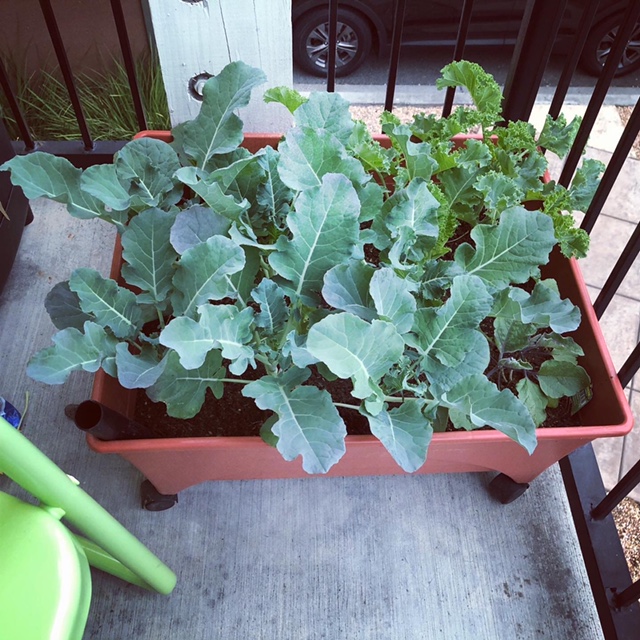
So I have some stops along the road for you, as we continue onward, trying to feed ourselves and our family and friends in ways that make sense. Let’s go in a consecutive sort of way. Sometimes we do arrive in unexpected places. Sometimes the surprise is a joy and a delight. Sometimes we have to learn and try again. In any case, this particular journey started with lots of bits of herbs and stems (from the store and my Aerogarden), with a sustainably-farmed beef kidney in the freezer, and with some young curly kale that was growing in a container on our terrace and some cherry tomatoes that were threatening to go the way of all produce.
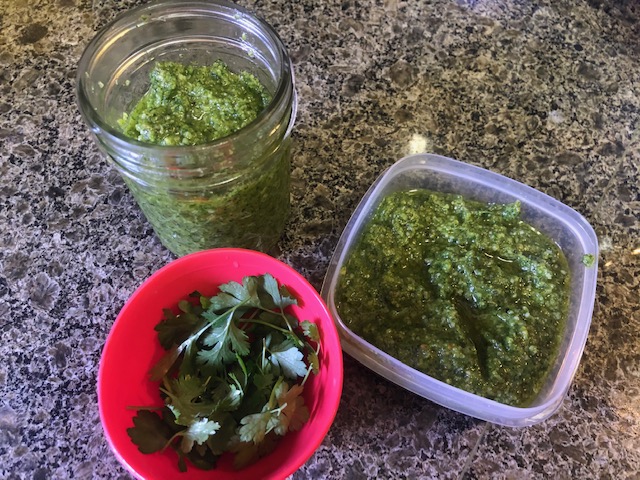
The beef kidney led to deviled kidneys on toast, which led to making beef tallow (who would have thought that), which let to Kotlet Shabowy (Polish-style pork cutlets). The herbs led to an All-Herb Pesto (even dill!),Herb-Stem Broth, and Pesto Macaroni and Cheese (shocking and delicious!). And the kale led to Roasted Tomatoes with Kale/Basil Oil and Burrata.
I hope you enjoy these and will consider trying them! And now I will leave you with a thought from the apostle Paul, who lived through a lot of aggravation, more than most of us have, and who wrote that it all ends up leading to hope … and hope will never disappoint us.
And a really fine ending for a summer afternoon … a Coffee Shakerato!
Eat well and be hopeful!
Romans 5:1-5 Therefore, since we are justified by faith, we have peace with God through our Lord Jesus Christ, through whom we have obtained access to this grace in which we stand; and we boast in our hope of sharing the glory of God. And not only that, but we also boast in our sufferings, knowing that suffering produces endurance, and endurance produces character, and character produces hope, and hope does not disappoint us, because God’s love has been poured into our hearts through the Holy Spirit that has been given to us.
All-Herb Pesto
50 grams Romano, Parmesan, or Asiago 60 grams walnuts, toasted in a dry pan 2 cloves garlic, chopped 2 scallions, roughly chopped 2 cups packed tender herb leaves (such as dill, parsley, cilantro, basil, and oregano) ½ cup extra virgin olive oil ½ tsp salt Freshly ground pepper to taste
In food processor, blitz cheese till grated, then add walnuts, garlic, and scallions, and process until finely chopped. Add herbs, salt, pepper, lemon zest, and juice, and continue to process, drizzling in oil, until rather smooth. Store in the refrigerator in a jar, covered with a thin layer of olive oil.
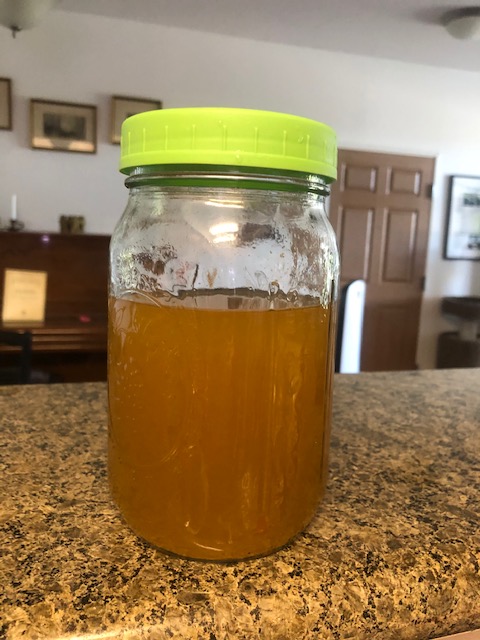
Herb Stem Broth
2 cups of herb stems 1 head of garlic, unpeeled, halved across its equator ½ large onion, cut into chunks 1 large carrot, cut in pieces 1 ripe tomato, chopped, or 10 or so cherry tomatoes, halved ½ tsp salt 1 tsp whole peppercorns 1 quart water
Put everything in a pot and add water to cover (about 1 quart). Simmer partially covered for 2 hours. Strain, squeezing out as much as the broth from the solids as possible. Use wherever broth is called for.
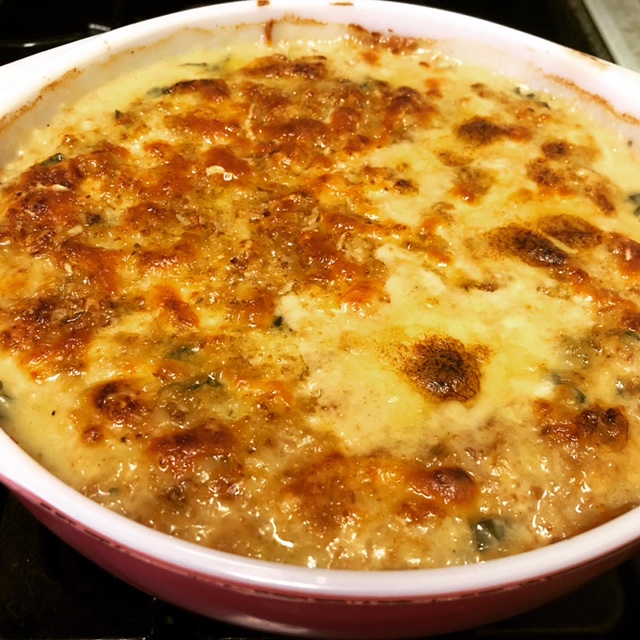
Pesto Mac and Cheese
2 tblsp butter 2 tblsp flour 2 cups whole milk 2 cups grated cheddar ½ tsp salt Freshly ground pepper ¼ cup all-herb pesto 2 cups uncooked short macaroni (elbows, penne, etc) 2 cups chopped fresh kale, spinach, or other greens ½ cup grated Parmesan, Romano, or Asiago 3 tblsp butter 1 tsp freshly ground pepper ½ cup fresh or panko breadcrumbs
Make cheese sauce: Melt butter in a heavy bottomed saucepan on medium heat. Add flour and stir with a wooden spoon for 2 to 3 minutes, until lightly colored. Whisk in milk gradually, stir until thickened, add cheddar, salt, and pepper, and heat until melted. Turn off heat, add in the pesto, and stir to combine.
Cook pasta in salted water 2 minutes short of instructions on package. For last 4 minutes, add chopped greens to boiling water. Drain pasta and greens, and add to sauce. Mixture should be rather loose and soupy. If too thick, add more milk and combine.
Meanwhile, melt butter in a small pan. Mix in breadcrumbs, Parmesan, and pepper.
Preheat oven to 350. Butter an 8 x 8 baking dish. Pour the pasta into the baking dish. Top with the breadcrumb mixture.
Bake 30 to 40 minutes, until bubbly and crisp.
Deviled Kidneys on Toast
1 beef kidney (about 1 lb) 2 tblsp butter Salt and freshly ground pepper 1 medium shallot, thinly sliced ¼ cup red wine 2 tsp Dijon mustard 1 ½ tblsp tart jam (such as currant, lingonberry, or raspberry) Dash of Worcestershire sauce ¼ cup heavy cream About 2 tblsp chopped parsley or chives
Cut the fat away from the kidney with a small, sharp knife (set the fat aside). Cut the kidney into bite-sized pieces (about 1 inch).
Melt the butter, sprinkle the kidney pieces with salt and pepper, and sauté on medium-high heat for about 4 minutes (don’t overcook them; they should still be a little pink inside). Remove the kidney pieces to a plate. Add the shallots to the pan and sauté until just beginning to brown (add more butter to pan if necessary). Add wine and cook down for a couple of minutes, until reduced by half, then add mustard, jam, and Worcestershire. Mix well, then add cream and heat to simmering. Add kidney pieces back in, and reheat.
Serve on buttered toast, and sprinkle with chopped parsley or chives.
Beef Tallow
Cut any bits of meat away from the beef fat, and cut the fat into very small pieces. Over very low heat in a small heavy saucepan, cook the fat until it is all rendered and the solid bits of fat are crispy. This can take from 45 minutes to two hours. Let cool briefly (but not completely, or it will solidify), strain through cheesecloth, and pour into a small glass jar. You should have about 3 tablespoons — not much, but enough to make your Kotlet Schabowy! (If you want to double the recipe and make 2 beef kidneys, to serve 4 people, you’ll have enough tallow to put some away. It will keep in the fridge for a very long time.)
Put the crispy bits on a small plate and sprinkle with salt and pepper for snacking.
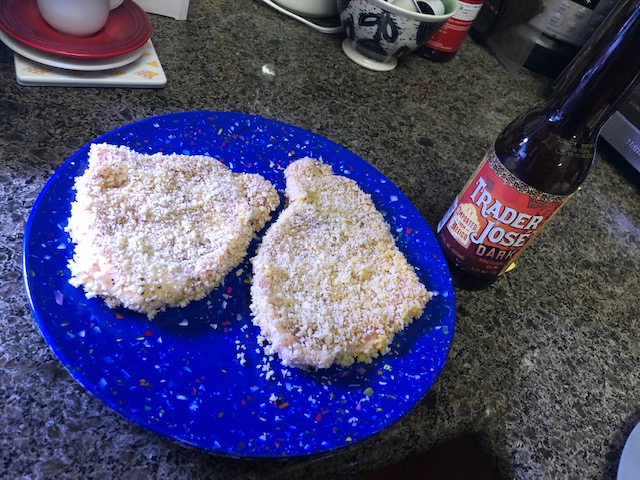
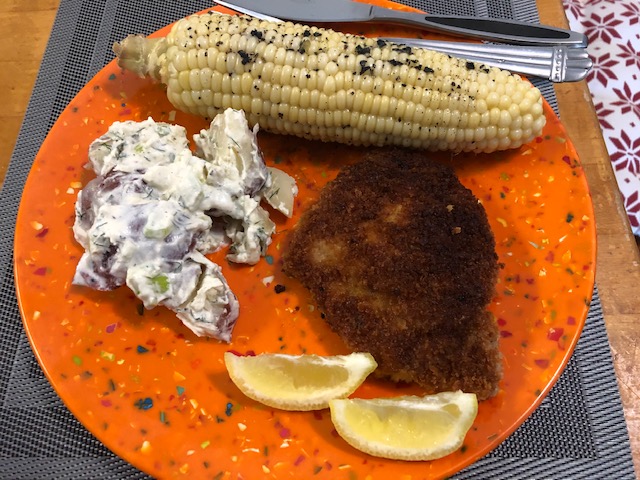
Kotlet Schabowy (Polish-style breaded pork)
2 boneless loin pork chops Salt and freshly ground pepper 2 tblsp flour 1 egg ½ cup panko breadcrumbs 2 tblsp beef tallow
Pound the pork chops between 2 sheets of plastic wrap or wax paper as thinly as possible. (Use a meat mallet, or if you don’t have one, you can use an empty wine bottle or beer bottle) Season the chops with salt and pepper.
Arrange 3 shallow bowls with flour in one bowl, beaten egg in the second, and panko crumbs in the third. Dredge each chop first in the flour, shake off excess, dip into egg, let excess drain off, then dredge in crumbs. Set the breaded chops aside on a plate.
Melt the beef tallow in a large, heavy frying pan on medium heat. Cook about 5 minutes per side, until browned and crispy. Serve with lemon wedges.
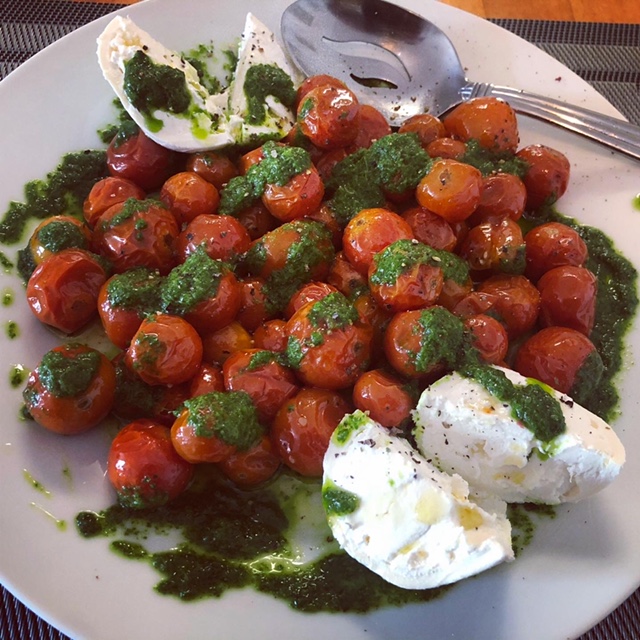
Roasted Cherry Tomatoes with Kale/Basil Oil and Burrata
1 lb (more or less) cherry or grape tomatoes Kosher salt and pepper Pinch of sugar Extra virgin olive oil ( ½ cup plus) 2 cups tender kale A handful of basil leaves 2 cloves garlic, roughly chopped Burrata
Preheat oven to 325. Place the tomatoes in a roasting pan and add enough olive oil to coat them. Sprinkle with salt and a pinch of sugar and mix well. Roast for 45 minutes, until starting to split. Allow to cool.
Meanwhile, blanch kale for 4 minutes. Squeeze dry and chop roughly. In a blender or food processor, blend with ½ cup olive oil, basil, garlic, a little salt, and pepper.
Put tomatoes and burrata on a plate and drizzle with the kale oil. Serve with toasted bread. (If you have any leftover tomatoes and kale oil, crush the tomatoes a bit and mix with pasta for a yummy pasta salad.)
April 30, 2020: This Sunday is that annual Sunday following Easter called “Good Shepherd Sunday.” Every year we have a bit of the gospel of John that helps us reflect on Jesus as the shepherd of the sheep. In this year’s passage, he is described as the gate, the gatekeeper, AND the shepherd! All those things! – much food for thought.
But it is the end of Sunday’s passage that always strikes me. Jesus talks about the pasture that is made available to his own sheep. He says: “I came that they may have life, and have it abundantly.”
Abundant life. What is that? This may not seem like a time of so much abundance. In some places, food is running short. This week there were news reports that there may be a shortage of meat in the US because so many of the workers who process the meat are not able to work. As we hunker down in our homes, sometimes with our whole families, space may not seem so abundant. For some of us, it seems the workload has been – at least – doubled, with all the video meetings, communications, and extra planning. Time may not seem so abundant either.
I often think of the Mennonite concept of “enough.” We don’t need more than – well, more than we need. We often think we need more. But if we reflect on what really IS “enough,” we might think about what we need and want in a new way. AND … I think this includes finding abundance in what seemed like scarcity.
Mixing in.
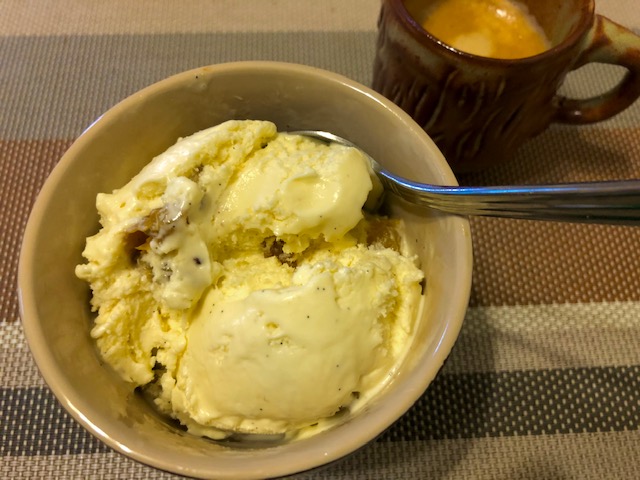
So I have two recipes this week that I think reflect abundance. First, a recipe for a “mushroom side dish,” made from half a package of mushrooms that I was concerned were about to go slimy on me. (And what could be worse than a slimy package of mushrooms in a pandemic? But I caught them in time.) It could be used as a delicious little side dish, on rice, or even on crackers. And, second, a recipe for rum raisin ice cream. (I have actually been using appliances that were closeted for 20 years, moved in boxes from apartment to apartment to house – I dug them out, and now I am making bread, yogurt, and FABULOUS ice cream – in my Cuisinart ice cream maker.) So I thought, what delicious thing could I make out of what’s here? Perhaps that bit of dark rum and some raisins could be pressed into service. Amazingly, I had just enough, as well as a single vanilla bean, called for in a recipe I found (on recipegirl.com, with some adapations). I even made ice cream sandwiches with some slices of frozen leftover Depression Chocolate Cake! It it is absolutely the most fabulous rum raisin ice cream these taste buds have ever come across. (And if that isn’t the very definition of abundance, I don’t know what is.)
There are many angles on life lived abundantly!
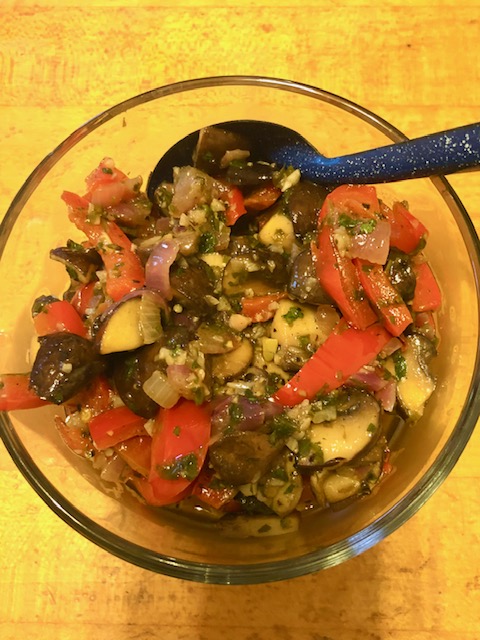
Mushroom Side Dish This is for 4 oz of any kind of mushrooms. (If you have a whole 8 oz package, double everything.)
Tasty shrooms!
4 oz mushrooms, sliced 3 tablespoons olive oil ½ medium onion, diced ½ red pepper, thinly sliced 2 cloves garlic, minced 2 tablespoons vinegar (I used red wine vinegar, but any kind would be good) ¼ cup tender herbs (parsley, basil, dill, tarragon, cilantro, or a combination), chopped fine Salt and pepper
Sauté shrooms in oil on medium heat for 5-7 minutes. Sprinkle with salt and pepper. Add onion and red pepper, and continue to cook for about 3 minutes, till pepper starts to look soft. Add garlic, cook for one minute. Add vinegar, stir, and cook 3 minutes more. Off heat, mix in herbs, and taste for seasoning.
Good warm or cold! (as a side dish, over rice, or on crackers)
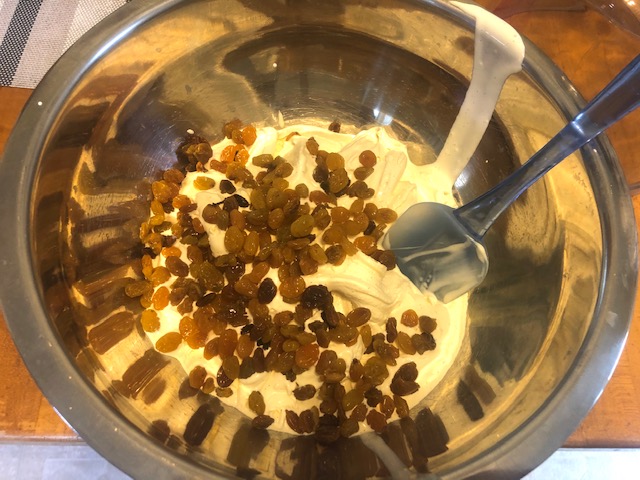
Rum Raisin Ice Cream (You will need an ice cream maker.)
½ cup dark rum ⅔ cup raisins 3 strips orange peel 1 cup whole milk ½ vanilla bean, split ¾ cup sugar Pinch salt 4 egg yolks 1½ cups heavy cream 2 oz cream cheese
Put raisins, rum, and orange peel in a small saucepan. Bring to a boil over medium heat. Remove from heat, cover, and set aside.
Combine milk, ½ cup sugar, salt, and vanilla bean in a heavy-bottomed saucepan. Heat over medium heat until almost boiling, then remove from heat. Cover and steep for 30 minutes.
While milk steeps, combine remaining ¼ cup sugar with egg yolks in a bowl and whisk until pale.
Put the cream in a large bowl and set bowl in a larger bowl or pot of ice water.
After 30 minutes, remove the vanilla bean from milk, scrape seeds into the mixture, and discard the pod. Heat milk just to boiling, then remove from heat.
SLOWLY drizzle the egg mixture into the hot milk, whisking all the while, until combined. Pour the mixture back into the saucepan and heat on medium, stirring constantly with a wooden spoon, just until the mixture coats the back of the spoon. (Watch like a hawk, or you will have scrambled eggs.)
Remove from heat, then whisk in cream cheese. Pour the custard into the bowl of cream, and leave to cool for about 30 minutes, stirring occasionally. Refrigerate in a container overnight.
Drain the raisins, take out the peel, and add the liquid to the cooled custard. Churn in an ice cream maker. After churning, mix in the raisins, then freeze for several hours or overnight, until more or less solid.
Yummmmmm!!
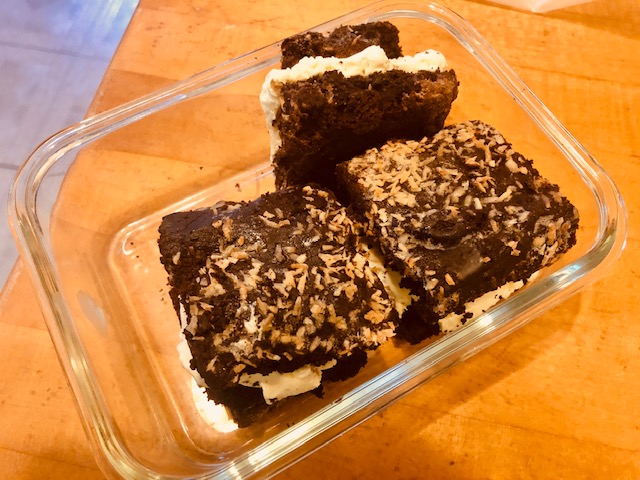
Rum raisin sandwiches with leftover cake, frozen.WOW.
(see instructions below for dyeing eggs from natural ingredients!)
After Easter, despite Jesus’ last words, it is not finished!
We have been catapulted from the Good Friday that we, our world, our country, our communities, and our loved ones have found ourselves in – into Easter! Now, you might say that in a very real sense, we are still deep in Good Friday. But then, what is Easter without Good Friday? What is light without darkness? What does resurrection mean to us without death? We cannot pretend that Good Friday never happened; indeed, it is happening now, in our lives.
Jesus’ life ends in John with his words, “It is finished.” What he had come to do had been accomplished. But for the women in Sunday’s Easter gospel it was not finished. They left the tomb quickly with fear and great joy, and on the way, Jesus greeted them and sent them forth. It was not finished for those women, or for the disciples – and it is not finished for us.
Easter is only our beginning! Its grace will take us through our lives, wherever we may be headed, for how long we know not. Still, we know that Jesus takes us beyond darkness and death. It is finished – and yet not finished. Today we begin anew. So today, let us cook with what we have, let us live, let us welcome Easter.
Christ is risen indeed! Alleluia, Amen!
And here are a couple of delicious things (as the journey on the theme #whatsinthefridge continues) made from what was left after coloring our eggs with natural ingredients. What could we do with these bright chopped cooked beets and liquid we soaked the eggs in (having a little vinegar in it), and the red cabbage with liquid? Not to mention the MANY MANY red and yellow onions we had in a bag in the fridge after using their skins to make the vibrant colors!
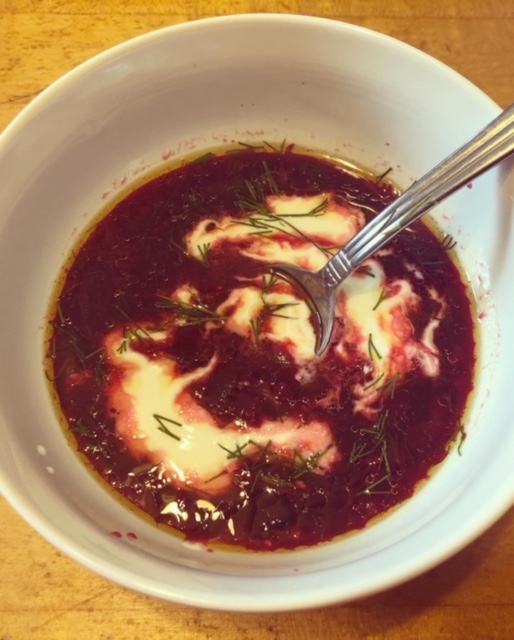
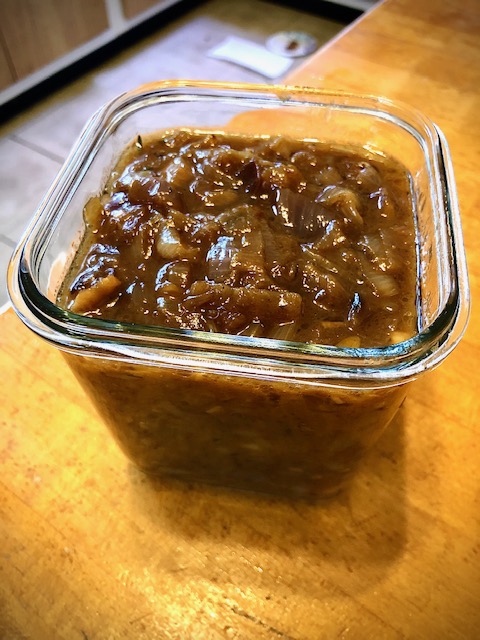
Well – here are recipes for a lovely little batch of borscht and a braised onion sauce for pasta. Enjoy!
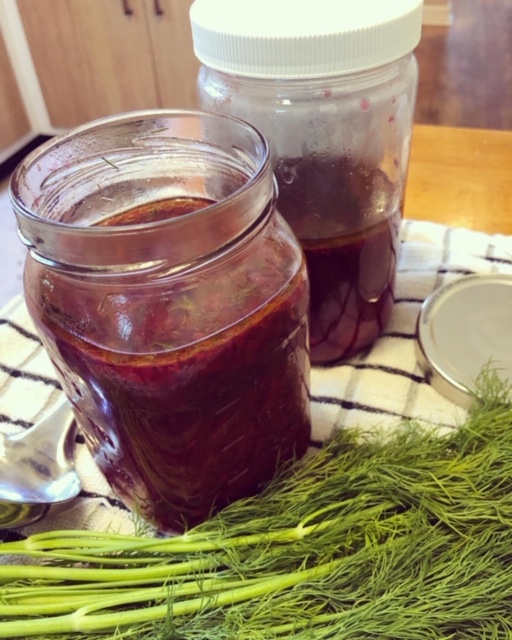
After the Eggs Borscht
After you’ve colored your beautiful eggs, don’t throw away the beets and red cabbage and the liquid! It’s just vegetables, water, and vinegar – why not use it for soup? You can make this great little borscht, good hot or cold. If you didn’t use the cabbage for coloring your eggs (but I hope you did because the blue eggs are so pretty!), add it raw as indicated below.
2 tablespoons olive oil 2 carrots, diced ½ cup onion (any kind, could include shallots, leeks, or scallions), chopped ½ cup potato (peeled or not), diced 1 cup cabbage (red or green), chopped (or cooked red cabbage and liquid left from coloring eggs) 2 cloves garlic, minced 2 cups broth (vegetable, chicken, or beef) 1 bay leaf Beets and liquid left from coloring eggs 1 tablespoon fresh dill, roughly chopped 2 tablespoons lemon juice 1 teaspoon lemon zest 1 tablespoon honey, sugar, or agave Salt and pepper
Sour cream or yogurt for serving
Heat oil over medium heat, and add carrots, onions, potatoes, and cabbage (if using uncooked cabbage). Sprinkle with salt and pepper and cook for 10 minutes, till somewhat softened. Add garlic and stir for 30 seconds. Add broth and bay leaf, bring to boil, and simmer 25 minutes. Add the reserved chopped beets and liquid you saved from coloring the eggs (if you have reserved cabbage and liquid, add those now too). Simmer for 5 minutes to blend flavors. Add honey, dill, lemon juice and zest, and taste for seasoning.
Serve hot or cold with sour cream or plain yogurt.
After the Eggs Onion Sauce for Pasta
This recipe is based on James Beard’s braised onion sauce (Beard on Pasta). I have doubled the ingredients since I had so many onions! The recipe could be cut in half to use a pound and a half, either red or yellow or both, which would be closer to Beard’s original recipe. This amount will certainly allow you to freeze some.
2½ sticks of butter 3 pounds of onions (red or yellow), sliced 6 cloves of garlic, sliced thin 2 tablespoons of sugar A few sprigs of thyme (if you like, tied together with kitchen twine) Salt and pepper to taste ½ cup Madeira Salt and pepper Parsley, chopped Pasta (firm pasta such as penne, rigatoni, or farfalle, although any type would be great!) Grated cheese (such as Parmesan, Grana Padano, or Romano)
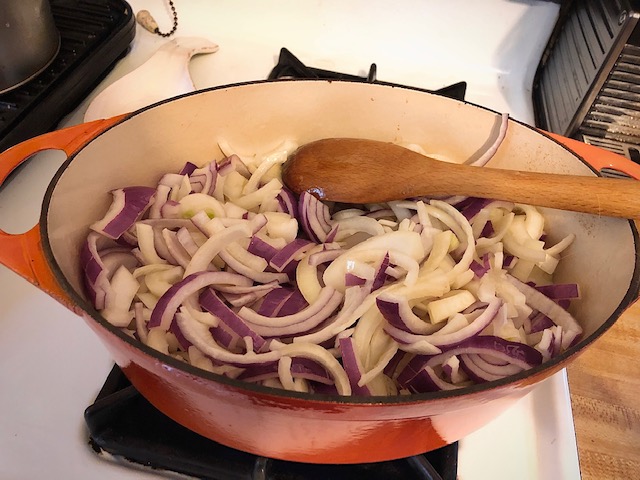
Melt butter in a large heavy-bottomed pot or Dutch oven. Add onions, and sprinkle with salt and pepper. Cook over medium heat till translucent (10 minutes), stirring often. Add sugar, garlic, and thyme sprigs, and cook uncovered for an hour, stirring often, until caramelized and saucy. Fish out and discard thyme sprigs. Add Madeira, simmer 5 minutes more, and taste for seasoning.
Cook pasta, reserving about ½ cup pasta water. Return pasta to pot, and off heat, toss with pasta, grated cheese, a bit of pasta water, and parsley.
It’s the eve of the Resurrection, and in this difficult time, we are longing for life. The egg is a symbol of spring and life (of Easter AND Passover), and has been a reliable, available, and inexpensive source of protein and deliciousness for as long as anyone can remember.
But the standard egg color kits are NOT so available right now (unless you had yours stashed away from last year). Here’s something fun and natural and healthy, using many ingredients you may already have on hand. We made five colors, dyeing a dozen hard boiled white eggs, and so the amount of material needed was reasonable. That is to say, a cup of onion skins involves a lot of onions!
And I am so happy with what became of the leftovers after dyeing … a braised onion pasta sauce (oh my gosh, so good), and a lovely little batch of borscht. Check back here in a day or so for those recipes and photos!
Start by boiling your eggs. White eggs are good, but brown ones also work and will result in a deeper, different color. Cover the eggs with cold water, bring to a boil, simmer for one minute, turn off the heat and let sit covered for 10 minutes, and they will be just nicely cooked. (Some say that if you add a bit of salt to the water, it will help keep them from cracking. But I never do that.) After 10 minutes, drain, cover with cold water, and dry before coloring.
THEN get out your smallish pots. To 1 cup of water, add 1 tablespoon white vinegar and one of the following:
1 cup chopped red cabbage (blue eggs)
1 cup shredded beets (pink eggs)
1 cup rinsed yellow onion skins (orange eggs)
1 cup rinsed red onion skins (maroon eggs – I recommend one soak because after too long they start to be more of a brownish color)
2 tablespoons turmeric (yellow eggs – there will be some turmeric debris, so give them a gentle rinse with cool water when they are done soaking)
Simmer the water and ingredients above for half an hour. Cool, then strain. Submerge the eggs in the liquid and put in the fridge for a couple of hours. (1 cup of water plus the ingredients above will cover 2-3 eggs in a vertical sort of container. Try glasses, measuring cups, etc., so that the eggs are covered. If not completely submerged, gently swish them around occasionally.) If you wish, after a while take them out and let them dry, then put them back in for another two hours or so. For shiny eggs, massage dried colored eggs with a neutral vegetable oil and polish with a paper towel. These are so beautiful! (Show them off right away because the oil does get absorbed by the shells after a while.)
After I’ve traveled through all the online worship services, I’ll be back with the great recipes made from the leftovers! DON’T THROW AWAY THE CHOPPED COOKED CABBAGE AND BEETS AND THEIR LIQUID. I mean, it just had eggs soaking in it, right? Still good for soup!
Have a beautiful, blessed Easter, wherever you are, alone or together, online, listening to the radio, watching television, eating frozen macaroni and cheese. or a roast leg of lamb with jus and asparagus. It is all a blessing.
Hard Times (from the reading from Exodus for the 3rd Sunday in Lent)
“Is the Lord among us, or not?” That was the question. The people of God had about had enough. They had been traveling for a long time in the wilderness, and they had no water. They were thirsty, and they wanted to go back to Egypt. They complain to Moses, who cries to the Lord, “What am I supposed to do with these people?”
But God gets right on the problem – he tells Moses to gather the elders, take your staff, strike the rock, and there will be water. Now the people can drink. God has spoken to the people’s question: “Is the Lord among us, or not?”
These days we are surely asking, where is God? Are things going to get a lot worse before they get better? Who knows if the Lord is among us, or not?
Presiding Bishop Elizabeth Eaton (of the Evangelical Lutheran Church in America) suggests that our Lenten fast may actually be a fast from physical touch, and she says, “Absence makes the presence of God more profound.” Now that’s profound, isn’t it? And we are still together, even if not in the same physical space! We are meeting by video, we are texting, we are talking on the phone again. And, as Bishop Eaton points out, Jesus has said, “Remember I am with you, to the end of age.” That is – the Lord is among us.
And we have to eat. We are thankful and blessed to have enough in the fridge, in the freezer, in the pantry, to keep us going with occasional forays and deliveries. We have more squirreled away than many folks, I imagine, based on my penchant for accumulating pantry staples, freezer supplies, and quirky ingredients. My son has told me, “You are so Little-House-on-the-Prairie!” because I make bread, pasta, yogurt, stock, and all sorts of things. So now we are making our way through the reserves.
So in this challenging time, let our souls (and bodies) be nourished! Let’s use up our leftovers, the things that are teetering on the brink of expiration, the bits and pieces we thought we didn’t need. In these desperate times, we may learn new tricks. We may learn innovative techniques from the experts and discover unusual (to us) new tastes.
One thing that has been uniquely gratifying has been to try to think creatively about what under other circumstances I might have tossed. A rather limp quarter of an uncooked cabbage, shredded, plus some chopped scallions and celery, those last two carrots diced up, a can of artichoke hearts, half a jar of roasted peppers, and some capers (and garlic, of course) can become a rather delicious marinated vegetable salad. (It is indeed a blessing to have garlic and onions on board, as well as some canned beans, veggies, and pickles – certainly a priority to keep in mind for the future!)
So for the next few weeks (or as long as we are discouraged from going anywhere and we have the ingredients), I’ll be posting some recipes that arose out of nothing, from what was in the back of the fridge or the cabinet or the bottom of the freezer. Only a couple of things needed to be purchased. #whatsinthefridge
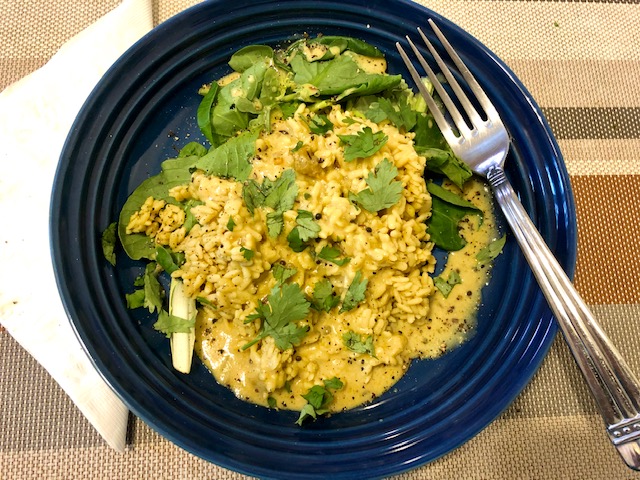
I had some homemade yogurt, a couple of weeks old, that looked ok but had a VERY tangy taste – really a bit too sour for comfort. I searched for recipes using “sour yogurt” and found this great recipe for Yogurt Curry on saffrontrail.com. Here it is, adapted somewhat. Of course, the yogurt wouldn’t have to be sour for it to be really good!
Gujarati Kadhi (Yogurt Curry)
1-1 ½ cups sour plain yogurt (or not sour; I used whole milk yogurt) 2 cups water 2-3 tablespoons flour (the recipe called for chickpea flour, but you could also use regular flour; I used teff flour) ½ teaspoon mild chili powder (such as ancho or chipotle) ½ teaspoon ground turmeric ½ teaspoon garam masala ¾ teaspoon salt 2 teaspoons sugar
Tadka(“tempering” spices in oil or ghee to release their flavors) 3 tablespoons ghee (or coconut oil) ¼ cup chopped onion Pinch of asafetida ½ teaspoon mustard seeds ½ cumin seeds 4 whole cloves 2 jalapeños, seeded and sliced Cilantro to garnish
Whisk 2 tablespoons yogurt with the flour. Whisk in the rest of the yogurt, water, spices, salt, and sugar. Heat in a saucepan over medium-low heat; simmer 6-7 minutes, whisking so the yogurt doesn’t break, till thickened. Remove from heat.
Make tadka: Heat oil in a small skillet over medium-high heat. Sauté onion until beginning to brown. Add asafetida and seeds. After seeds pop, add jalapeños and cloves, and cook one minute. Mix into yogurt mixture, simmer 5 minutes.
For those of us who are serious amateur cooks or those who just like to read about cooking, these days we are always hungry for something new. New techniques – cooking with foam, “sous vide,” freezing with liquid nitrogen, “deconstruction,” and other modern ways of doing things, join new ingredients that we never heard of or thought about eating before now, in what is for some an obsession, and for others just silliness.
But I am on board. I want to try new things. I think new things are exciting. As a Lutheran pastor in New Jersey, I like to think that this is a hallmark of my ministry these days – taking on new challenges, looking for new answers, meeting new people, encountering new cultures, thinking in new ways.
What does Scripture say about new things? Well, there seems to be a divide (as there so often is in Scripture, which does not always agree with itself). The author of Ecclesiastes, part of the Wisdom literature of the Bible, is claimed to have been written by one Kohelet, a king who advises his readers about the meaning of life. He writes, “What has been is what will be, and what has been done is what will be done; there is nothing new under the sun.” On the other hand, in Isaiah, God says, “I am about to do a new thing; now it springs forth, do you not perceive it?” The new thing God promises is to bring Israel back to Jerusalem from the Babylonian exile. Generations have read this as God’s promise to renew their own lives.
So join me on an exploration of new things! I’ve been enjoying trying all kinds of game lately, many of them heretofore unexperienced. Here is a recipe you may enjoy trying, or just reading about.
You can find kangaroo from local purveyors which will ship to you. Kangaroo has a beefy, slightly gamey taste, and is very lean. Don’t overcook it! I’m using a dry rub comprised of garlic, coffee, cocoa and chiles. Serve with mashed purple potatoes and Swiss chard that’s been cut in ribbons and sautéed with olive oil and garlic.
KANGAROO LOIN WITH COFFEE, COCOA AND CHILE SPICE RUB
For the rub: 1 tablespoon powdered coffee (not instant – buy powdered or pulverize in your coffee grinder) 1 tablespoon good quality cocoa 1 tablespoon ancho chile powder ½ tablespoon brown sugar 1 teaspoon salt 3 garlic cloves, made into a paste with the salt (use a mortar and pestle or a wide knife blade)
For the sauce: ¼ cup brandy ¾ cup heavy cream 1 tablespoon butter
Mix rub ingredients together. Rub all over kangaroo loin and let sit for half an hour. Heat oil in a cast iron pan and sear all over, not more than 3 minutes a side, then take your kangaroo’s temperature. Take it off the heat at 120°F for medium rare and let it rest, tented with foil, for 10 minutes (it will continue to cook). Medium rare is recommended, as kangaroo is very lean.
While the kangaroo is resting, add brandy to the pan. Light from the edge of the frying pan with a long match (stand back). After flames subside, cook down a minute, then add cream. Let reduce for a couple of minutes and swirl in butter. Taste sauce for salt and pepper. Slice kangaroo and spoon sauce over. There will just be a little sauce, but that’s all you need.
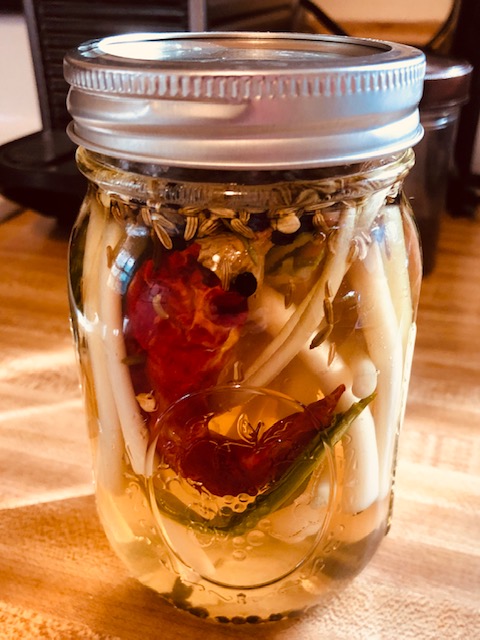
Nice with some pickled ramps — in season now! Recipe coming soon.















 Pastor's Palate